DiWALI: Diffusion Policy Learning in World Models via Latent Action Inference from Human and Robot Play
Abstract
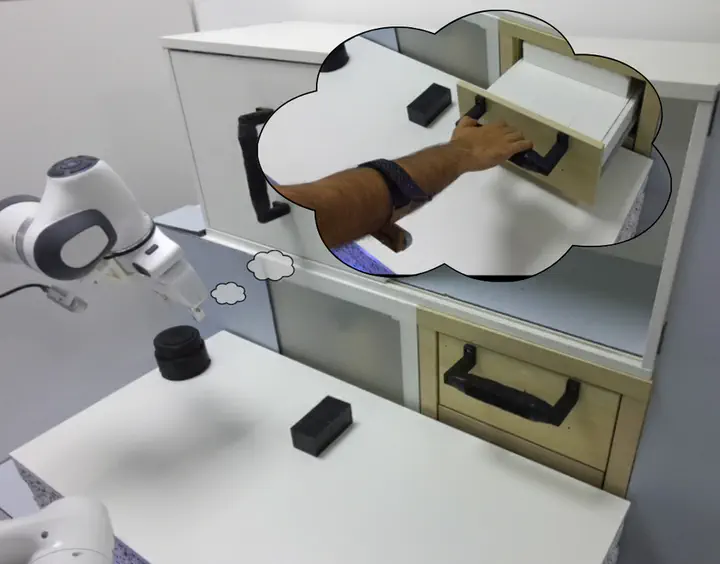
Learning robot manipulation is constrained by the availability of action-labeled robot data, for both imitation and world models. Humans can demonstrate skills in seconds, but their demonstrations lack the required robot actions. We introduce DiWALI, a framework that learns and improves diffusion policies within a world model trained on human and robot play. DiWALI infers latent actions from consecutive frames using an inverse dynamics model, enabling world model training without action labels, and grounds them in robot commands through a decoder trained separately on robot play. Skill policies are trained over latent actions from action-free human demonstrations and improved with reinforcement learning in imagination. On the CALVIN benchmark, DiWALI policies trained solely from human demonstrations substantially outperform baselines trained with robot demonstrations. Incorporating human play into the world model training also yields stronger policies after fine-tuning than using the same amount of robot play alone. Experiments on a physical robot show that skills learned primarily from human demonstrations are further improved in imagination with a world model trained on human and robot play. Together, these results demonstrate that human experience can support both manipulation skill acquisition and subsequent policy improvement, reducing reliance on action-labeled robot data. Videos, dataset and code are available at https://diwali.cs.uni-freiburg.de.

Iman Nematollahi
Postdoc in Robot Learning & AI for Oncology
My research interests include deep learning, world models, and reinforcement learning.